
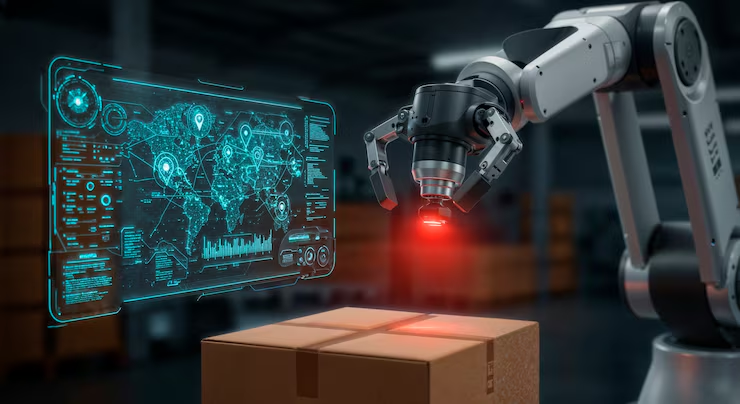
In the world of ecommerce, success is not just about having a great website or marketing strategy—it heavily depends on how efficiently a business manages its supply chain. From sourcing products to delivering them to customers, every step in the supply chain plays a crucial role in ensuring customer satisfaction and profitability.
However, managing supply chains has become increasingly complex due to rising customer expectations, global operations, and unpredictable market conditions. This is where artificial intelligence (AI) is transforming supply chain management by making it faster, smarter, and more efficient.
AI enables ecommerce businesses to forecast demand accurately, optimize logistics, manage suppliers effectively, and reduce delays. With real-time insights and automation, companies can gain complete visibility across their supply chain and make proactive decisions.
In this blog, we’ll explore how AI is revolutionizing supply chain management, its core applications, benefits, and strategic value for ecommerce businesses.
The Importance of Supply Chain in Ecommerce
The supply chain is the backbone of any ecommerce business. It includes:
- Procurement of raw materials or products
- Inventory management
- Warehousing
- Transportation and delivery
- Order fulfillment
A well-optimized supply chain ensures:
- Timely deliveries
- Reduced costs
- Better customer experience
On the other hand, inefficiencies can lead to:
- Delayed shipments
- Stock shortages or overstocking
- Increased operational costs
- Customer dissatisfaction
As ecommerce grows, businesses need smarter solutions to manage these challenges—and AI provides exactly that.
The Role of AI in Supply Chain Management
AI brings intelligence and automation to supply chain operations. It processes large volumes of data to identify patterns, predict outcomes, and optimize processes.
AI helps businesses:
- Make data-driven decisions
- Automate repetitive tasks
- Improve efficiency and accuracy
- Respond quickly to changes
By integrating AI into supply chain systems, ecommerce companies can move from reactive problem-solving to proactive planning.
Core AI Applications in Supply Chain Management
AI is transforming multiple areas of the supply chain. Let’s explore the key applications.
1. Demand Forecasting
One of the most critical aspects of supply chain management is predicting customer demand.
AI-powered demand forecasting analyzes:
- Historical sales data
- Seasonal trends
- Market conditions
- Customer behavior
This allows businesses to:
- Predict future demand accurately
- Prepare inventory in advance
- Avoid stockouts and overstocking
For example:
AI can predict increased demand for certain products during festivals or sales events.
Benefits:
- Improved inventory planning
- Reduced wastage
- Better customer satisfaction
2. Supplier Performance Analysis
Managing suppliers effectively is essential for a smooth supply chain.
AI helps evaluate supplier performance based on:
- Delivery timelines
- Product quality
- Pricing
- Reliability
With these insights, businesses can:
- Choose the best suppliers
- Identify risks
- Improve supplier relationships
AI can also predict potential disruptions, allowing businesses to take preventive action.
3. Route and Delivery Optimization
Logistics and delivery are critical components of ecommerce.
AI optimizes delivery routes by analyzing:
- Traffic conditions
- Weather data
- Delivery locations
- Fuel costs
This helps:
- Reduce delivery time
- Lower transportation costs
- Improve efficiency
For example:
AI can suggest the fastest and most cost-effective delivery routes in real time.
4. Inventory Management
AI enhances inventory management by:
- Tracking stock levels in real time
- Predicting replenishment needs
- Automating inventory updates
This ensures:
- Optimal stock levels
- Reduced storage costs
- Efficient warehouse operations
5. Warehouse Automation
AI-powered systems improve warehouse efficiency through:
- Automated picking and packing
- Smart storage systems
- Robotics and automation
This leads to:
- Faster order processing
- Reduced human errors
- Improved productivity
6. Risk Management
Supply chains are vulnerable to disruptions such as:
- Supplier delays
- Transportation issues
- Market fluctuations
AI helps identify risks by:
- Analyzing historical data
- Monitoring real-time events
- Predicting potential disruptions
Businesses can then:
- Take preventive measures
- Develop contingency plans
Operational Advantages of AI in Supply Chain
AI-driven supply chains offer several operational benefits.
1. Reduced Logistics Costs
AI optimizes transportation and operations, leading to:
- Lower fuel consumption
- Efficient route planning
- Reduced operational expenses
2. Faster Order Fulfillment
Automation and optimization enable:
- Quick order processing
- Faster shipping
- Shorter delivery times
This improves customer satisfaction and retention.
3. Improved Inventory Accuracy
AI ensures accurate inventory tracking, reducing:
- Stock discrepancies
- Overstocking issues
- Stockouts
4. Enhanced Efficiency
AI automates repetitive tasks, allowing employees to focus on strategic activities.
5. Better Decision-Making
With real-time insights, businesses can:
- Make informed decisions
- Respond quickly to changes
- Optimize operations
Strategic Value of AI in Supply Chain
Beyond operational improvements, AI provides significant strategic advantages.
1. Proactive Decision-Making
Traditional supply chains are reactive—they respond to problems after they occur.
AI enables businesses to:
- Predict issues in advance
- Take preventive actions
- Avoid disruptions
2. Scalability
As ecommerce businesses grow, supply chains become more complex.
AI helps:
- Manage increased demand
- Scale operations efficiently
- Maintain performance
3. Competitive Advantage
Businesses using AI can:
- Deliver faster
- Operate more efficiently
- Offer better customer experiences
This creates a strong competitive edge.
4. Global Expansion
AI-powered supply chains make it easier to:
- Manage international operations
- Handle cross-border logistics
- Optimize global distribution
Real-World Use Cases
AI is already being used by leading ecommerce companies in supply chain management.
1. Smart Warehousing
AI-powered robots handle:
- Sorting
- Packing
- Inventory tracking
2. Predictive Maintenance
AI predicts equipment failures, reducing downtime in warehouses and logistics.
3. Dynamic Delivery Systems
Real-time route optimization ensures faster deliveries.
4. Automated Inventory Replenishment
AI automatically reorders stock based on demand predictions.
Challenges in AI Implementation
Despite its benefits, implementing AI in supply chain management comes with challenges.
1. High Initial Investment
AI systems require:
- Advanced technology
- Skilled professionals
- Infrastructure setup
2. Data Dependency
AI relies on high-quality data.
Poor data can lead to:
- Inaccurate predictions
- Inefficient operations
3. Integration Complexity
Integrating AI with existing systems can be challenging.
4. Change Management
Employees may need training to adapt to new technologies.
Best Practices for Implementation
To successfully implement AI in supply chain management:
- Start with clear goals
- Focus on high-impact areas like forecasting and logistics
- Invest in data quality
- Use scalable AI solutions
- Train employees and teams
- Continuously monitor and optimize
The Future of AI in Supply Chain
The future of supply chain management is intelligent, automated, and highly efficient.
Emerging trends include:
- Autonomous delivery systems
- AI-powered drones
- Blockchain integration for transparency
- Real-time supply chain visibility
AI will continue to evolve, making supply chains more resilient and adaptable.
Conclusion
AI is revolutionizing supply chain management in ecommerce by enabling faster, smarter, and more efficient operations. From demand forecasting and supplier management to logistics optimization and inventory control, AI enhances every aspect of the supply chain.
By leveraging AI-driven insights, businesses can reduce costs, improve efficiency, and deliver better customer experiences. More importantly, AI allows companies to shift from reactive problem-solving to proactive decision-making.
In an increasingly competitive ecommerce landscape, adopting AI-powered supply chain solutions is no longer optional—it is essential for sustainable growth and scalability. Businesses that embrace this transformation will be better equipped to meet customer expectations, expand globally, and achieve long-term success.

Leave a Reply