
Artificial intelligence (AI) is no longer a futuristic concept in ecommerce—it is already transforming how businesses operate and how customers shop. From personalized recommendations to automated customer support, AI has become a core component of modern online retail.
However, what we are witnessing today is just the beginning. As technology evolves, AI adoption in ecommerce is accelerating rapidly, paving the way for a future where shopping becomes more predictive, automated, and deeply personalized.
Over the next decade, AI will redefine every aspect of ecommerce—from product discovery and pricing to logistics and customer engagement. Businesses that embrace these changes early will gain a significant competitive advantage.
In this blog, we’ll explore the key trends shaping the future of AI in ecommerce and how brands can prepare for what’s coming next.
The Evolution of AI in Ecommerce
AI in ecommerce has evolved through several stages:
1. Basic Automation
Initially, AI was used for:
- Simple product recommendations
- Basic chatbots
- Rule-based automation
2. Data-Driven Personalization
As data collection improved, AI enabled:
- Personalized product suggestions
- Targeted marketing campaigns
- Customer segmentation
3. Predictive Intelligence
Today, AI is capable of:
- Predicting customer behavior
- Forecasting demand
- Optimizing operations
4. Autonomous Decision-Making (Future)
In the coming years, AI will:
- Make independent decisions
- Automate entire shopping journeys
- Interact directly with customers
This shift will redefine how ecommerce businesses operate.
Key Future Trends in AI-Driven Ecommerce
Let’s explore the most important trends that will shape the next decade.
1. Agentic Commerce
One of the most exciting developments is agentic commerce, where AI-powered agents act on behalf of customers.
These AI agents can:
- Search for products
- Compare prices
- Make purchase decisions
- Manage subscriptions
For example:
A customer’s AI assistant could automatically reorder groceries or find the best deals for electronics.
Impact:
- Reduced effort for customers
- Faster decision-making
- Highly personalized shopping
Businesses will need to optimize their platforms not just for humans, but also for AI agents.
2. Predictive Shopping Journeys
AI will move beyond reacting to customer behavior—it will start predicting it.
Predictive shopping journeys involve:
- Anticipating customer needs
- Suggesting products before customers search
- Automating purchase decisions
For example:
- Recommending winter clothing before the season starts
- Suggesting replenishment of frequently used items
Benefits:
- Increased convenience
- Higher conversion rates
- Improved customer satisfaction
3. Hyper-Personalization
Personalization will become more advanced and precise.
AI will consider:
- Real-time behavior
- Context (location, time, device)
- Emotional signals
This will enable:
- Dynamic product recommendations
- Personalized pricing
- Tailored marketing messages
Each customer will experience a unique shopping journey.
4. Invisible Checkout Experiences
The future of ecommerce will eliminate friction in the checkout process.
Invisible checkout means:
- No manual payment steps
- Automatic transactions
- Seamless purchasing
Examples include:
- One-click payments
- Subscription-based purchases
- Smart devices placing orders automatically
Impact:
- Reduced cart abandonment
- Faster transactions
- Improved user experience
5. Voice and Conversational Commerce
Voice assistants and conversational AI will play a bigger role in ecommerce.
Customers will:
- Search using voice commands
- Interact with AI assistants
- Make purchases through conversations
This creates:
- Natural interactions
- Hands-free shopping
- Faster decision-making
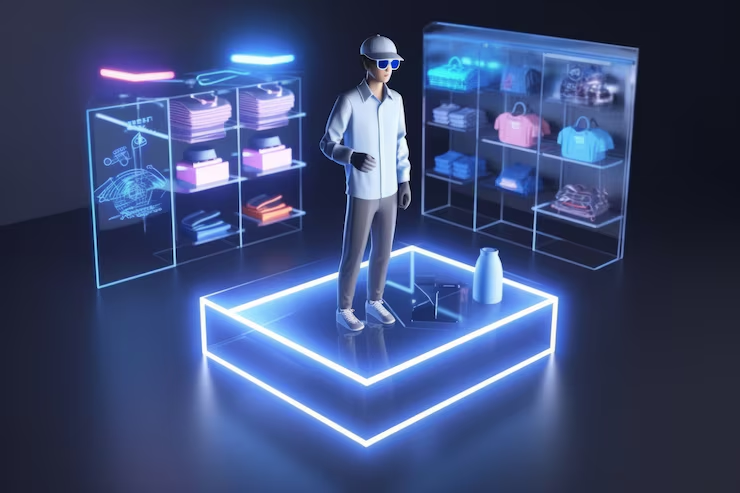
6. Visual and Augmented Reality Shopping
AI will enhance visual shopping experiences through:
- Image recognition
- Augmented reality (AR)
- Virtual try-ons
Customers will be able to:
- Try products virtually
- Visualize items in real environments
- Make confident purchasing decisions
7. Autonomous Supply Chains
AI will fully automate supply chain operations.
This includes:
- Demand forecasting
- Inventory management
- Logistics optimization
Autonomous systems will:
- Reduce delays
- Improve efficiency
- Lower costs
8. Ethical and Transparent AI
As AI becomes more powerful, ethical considerations will become more important.
Businesses will need to:
- Ensure data privacy
- Avoid bias in algorithms
- Maintain transparency
Trust will become a key factor in customer relationships.
Preparing for the Future of AI in Ecommerce
To stay competitive, businesses must start preparing today.
1. Invest in AI Technology
Adopting AI tools and platforms is essential for:
- Automation
- Data analysis
- Personalization
2. Focus on Data Quality
AI relies on high-quality data.
Businesses should:
- Collect accurate data
- Ensure data security
- Maintain transparency
3. Build Scalable Systems
Future ecommerce systems must be:
- Flexible
- Scalable
- Integration-friendly
4. Prioritize Customer Experience
AI should enhance—not replace—the human experience.
Focus on:
- Personalization
- Convenience
- Trust
5. Upskill Teams
Employees need to:
- Understand AI technologies
- Adapt to new workflows
- Leverage data insights
Business Impact of Future AI Trends
AI-driven ecommerce will have a profound impact on businesses.
1. Increased Efficiency
Automation will reduce manual effort and improve productivity.
2. Higher Revenue Growth
Personalization and predictive insights will drive:
- More conversions
- Increased sales
3. Stronger Customer Relationships
AI will enable:
- Better understanding of customers
- Personalized interactions
- Long-term loyalty
4. Competitive Advantage
Early adopters of AI will:
- Stay ahead of competitors
- Innovate faster
- Capture more market share
Challenges to Consider
While the future is promising, there are challenges:
1. High Implementation Costs
AI systems require significant investment.
2. Data Privacy Concerns
Handling customer data responsibly is critical.
3. Technological Complexity
AI systems can be complex to implement and manage.
4. Ethical Issues
Ensuring fairness and transparency is essential.
The Role of Innovation in Ecommerce
Innovation will be the key driver of success in the next decade.
Businesses must:
- Experiment with new technologies
- Adapt to changing trends
- Continuously improve
AI will act as a catalyst for innovation, enabling new business models and opportunities.
Conclusion
The future of ecommerce is being shaped by artificial intelligence. As AI continues to evolve, it will transform shopping experiences into something more predictive, automated, and personalized than ever before.
From agentic commerce and predictive shopping journeys to invisible checkout and hyper-personalization, the next decade will redefine how customers interact with brands. Businesses that embrace these trends early will gain a significant competitive edge.
However, success will not depend solely on technology. It will also require a strong focus on customer experience, data privacy, and ethical practices.
In the end, the future of ecommerce belongs to brands that can combine AI-driven innovation with trust, relevance, and speed. Those who adapt will thrive, while those who hesitate risk being left behind.

Leave a Reply